The Brick Moon: the war goes to orbit
The war has found its final frontier. High over the Brick Sea hangs a small gray moon, and in the armistice years both sides got there the hard way — drawing-board rockets, canvas pressure suits, riveted capsules with one porthole — and brought the war along. The Brick Moon is a whole new way to fight: real orbits, real burns, real silence, and a station made of actual bricks that both teams want very badly.
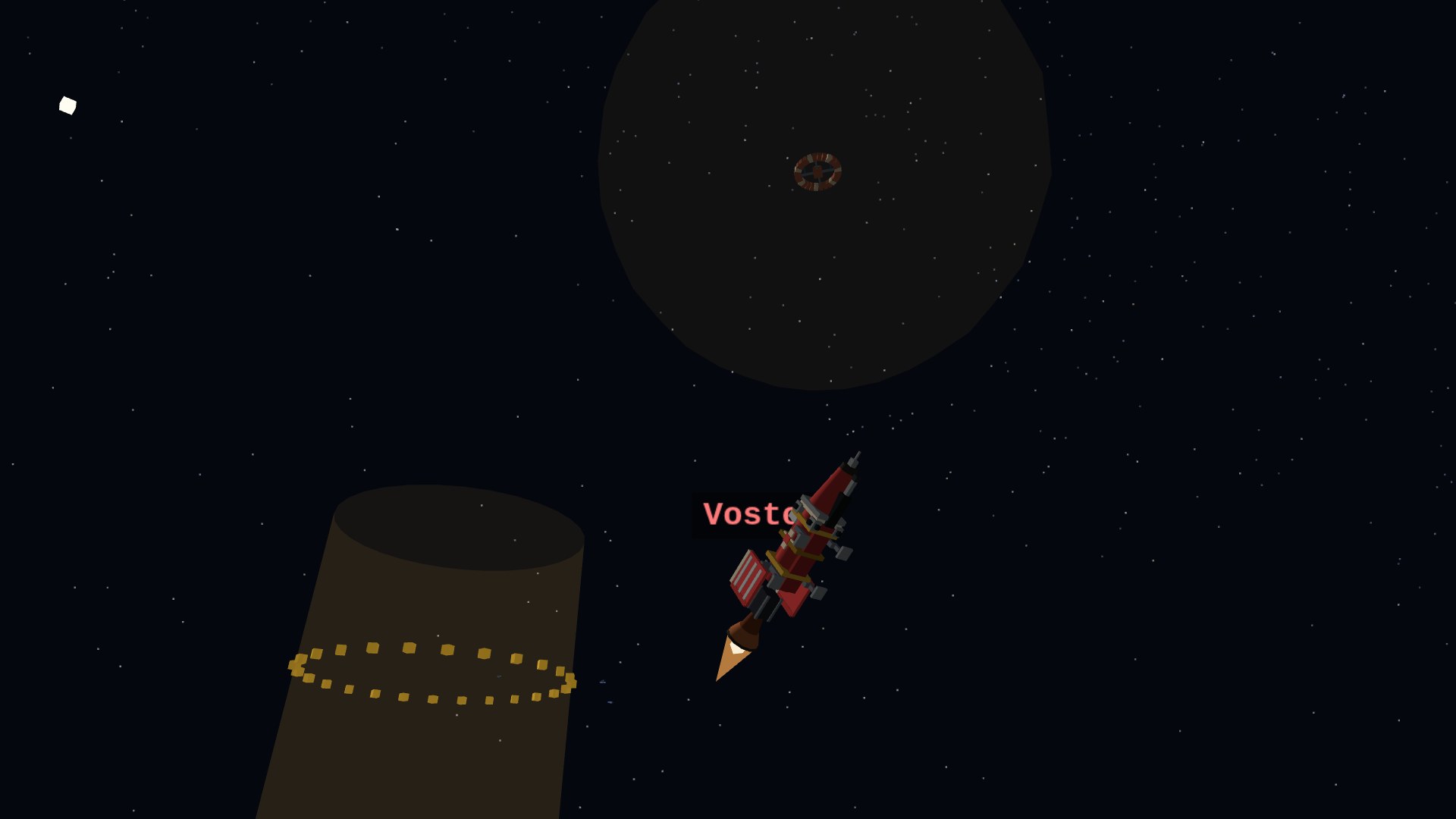
Every other sky in this war lies to you politely. Pull the stick and the plane goes where the nose points; ring up flank speed and the ship goes where the bow aims. The Brick Moon does no such thing. Your spacecraft is always falling — the only question is whether you're falling around the moon or into it — and the sooner you make peace with that, the sooner you'll be dangerous up there.
You arrive on orbit
The tower flies the boring part. Your cosmodrome's guidance handles the ascent off-screen, and the ship is handed to you already orbiting — coasting, engine cold, the war a short burn ahead — because up here coasting is free and fuel is everything. And from that first moment the flight director has the ship, flying a beautifully simple deal: you look, it flies. The stick and the mouse turn your gaze freely around the craft. Push the throttle in and the ship travels the way you're looking — up means up, down means down, ahead means ahead — while the director works out whatever strange burn the orbit actually demands (watch the nose sometime: it is almost never pointed where you're going, and that's the well being handled for you). Pull the throttle out and the director trims the lap circular and goes engine-cold: a held course up here costs nothing. All the while it keeps the low side of your orbit off the peaks and the high side under the ceiling — it will not fly you into the regolith to please your eyeline. Pilots who want the whole ship can switch the director off with P and fly raw RCS, with the gyro holds (K prograde, J retrograde) and the APO and PERI readouts doing the coaching — the orbit is still under there, undiluted, for anyone who wants to shake its hand.
One tank feeds everything you do: dodging, chasing, running home. Spend it all on the chase and the moon keeps you.
Down is faster
Here is the lesson every rookie learns over the Brick Moon, usually twice. There's an enemy ahead of you, in your exact orbit, plodding along at the same speed. Light the bell and burn straight at them — and you rise, slow down, and watch them pull away. Orbits don't work like roads. To catch something ahead of you, drop lower: a lower lap is a faster lap, and you reel them in from below. To let something behind you catch up, climb. The flight director speaks this language for you — look at your target, throttle in, and it flies whatever backwards burn the catch actually requires — but the moon rewards the pilot who knows why the nose just swung somewhere strange. The first time you use the trick on purpose — dropping low across the mare to rise up under an enemy who never checked below — you'll feel like a killer with an orrery.
The planet is in every firing solution
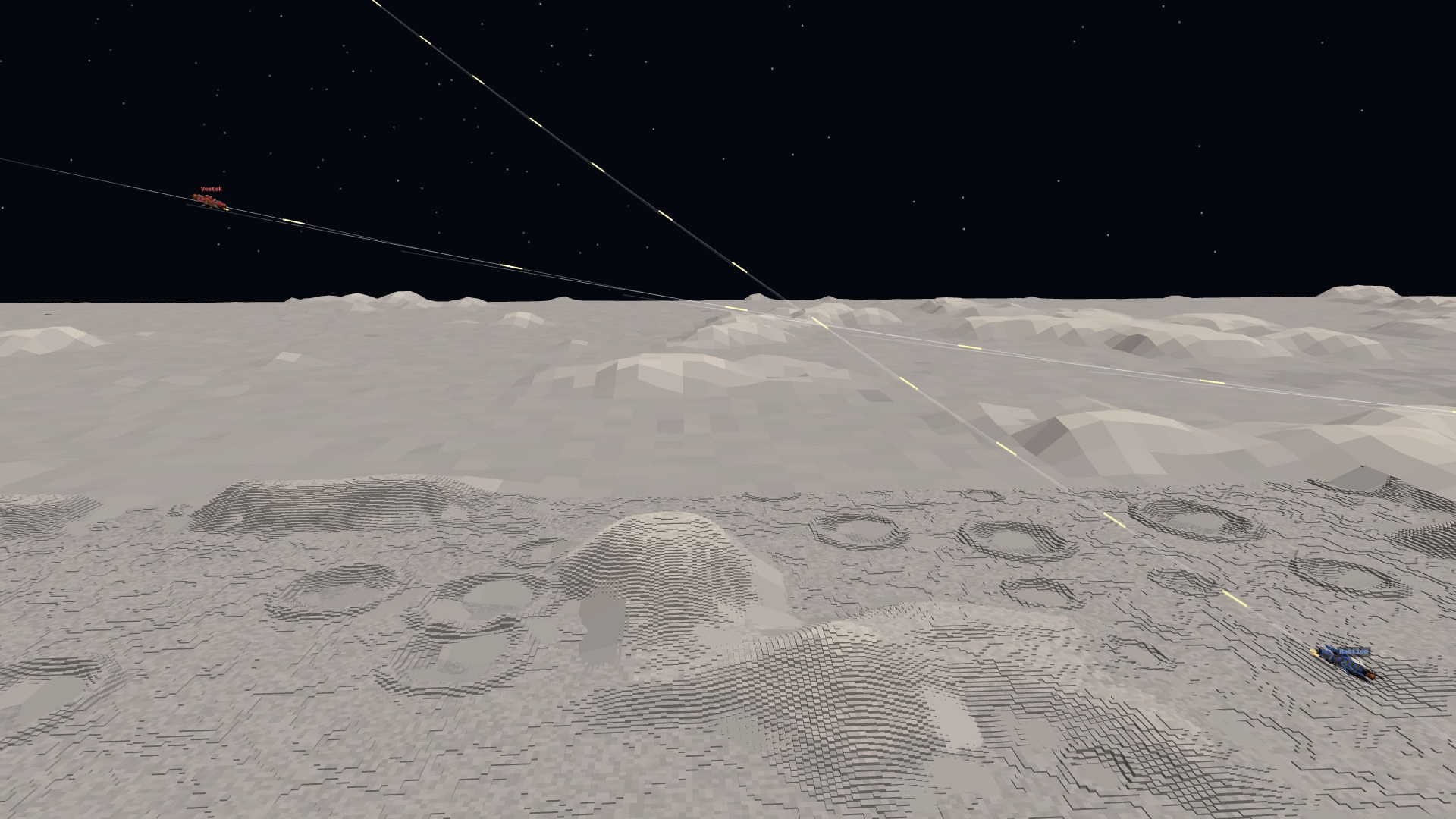
Your cannon shells leave the muzzle at three times escape velocity — the moon cannot hold them, and it cannot hold your aim either. Fire dead at a target a kilometre ahead and the stream climbs away high over the mark, because every round is a tiny spacecraft slung around a world too small to keep it. So your reticle is a fire-control computer: it flies the shot before you take it and shows you the mark that connects. Trust the mark, not your eyes. Your eyes evolved on flat ground, under a sky that gives bullets back.
The Bastion gun corvette carries the theater's exclamation point: an 85 mm heavy rifle whose recoil is real. Every round kicks the hull backward — a broadside is also a burn, and a captain who empties the magazine in one long fight will find her orbit quietly rewritten by her own gun. Newton rides every trigger up here.
The dark side keeps secrets
The sun over the Brick Moon never moves, so half the world is always night — and your orbit crosses into it every single lap. In the dark you're nearly invisible to enemy optics… until you burn, because a lit engine bell is the brightest thing in the sky and every telescope on both teams is looking for exactly that. So the theater's signature play writes itself: kill the engine before the terminator, coast through the shadow cold and quiet, and be waiting when your target glows against the sunrise line. If the DETECTED banner lights up, somebody's plot has you — change something. And when you need to vanish completely, run cold: radiators in, engine and guns offline, a submarine dive in vacuum.
And the moon itself is cover. The world is small enough that the horizon is real: a ship two kilometres out sets behind the curve like a sail dropping below the sea, and no telescope on either team can look through a planet. Dive low and you vanish from every plot; pop up over the bulge with your guns already laid, and you ARE the sunrise.
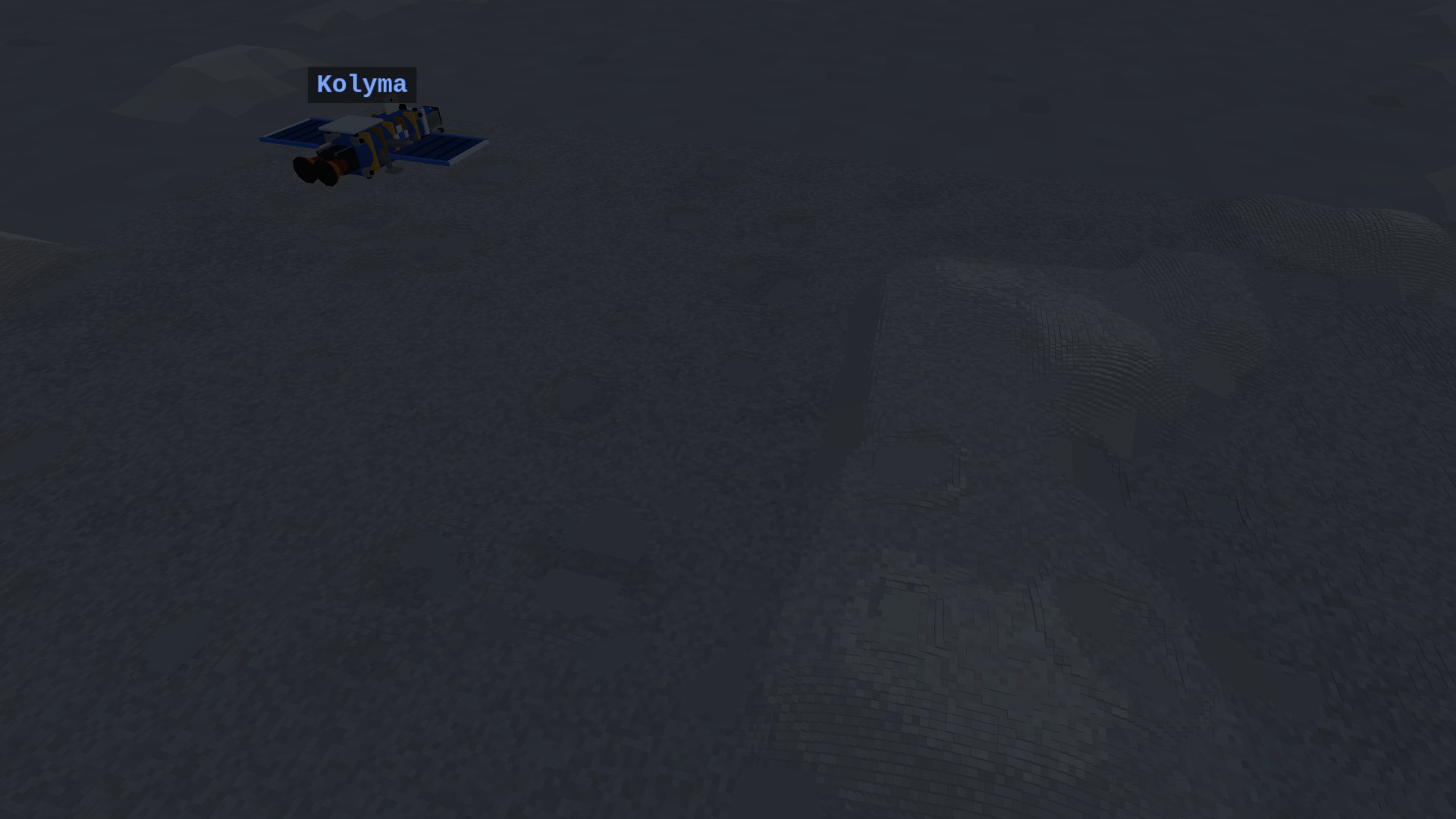
And space is silent — really silent. You hear your own engine through the airframe, your own guns as thuds in the structure, your own hull. Enemy fire? Enemy explosions? Nothing. A kill two hundred metres off your beam is a soundless bloom of light while the radio breathes static. You will not get used to it.
The plotted future, and a telescope
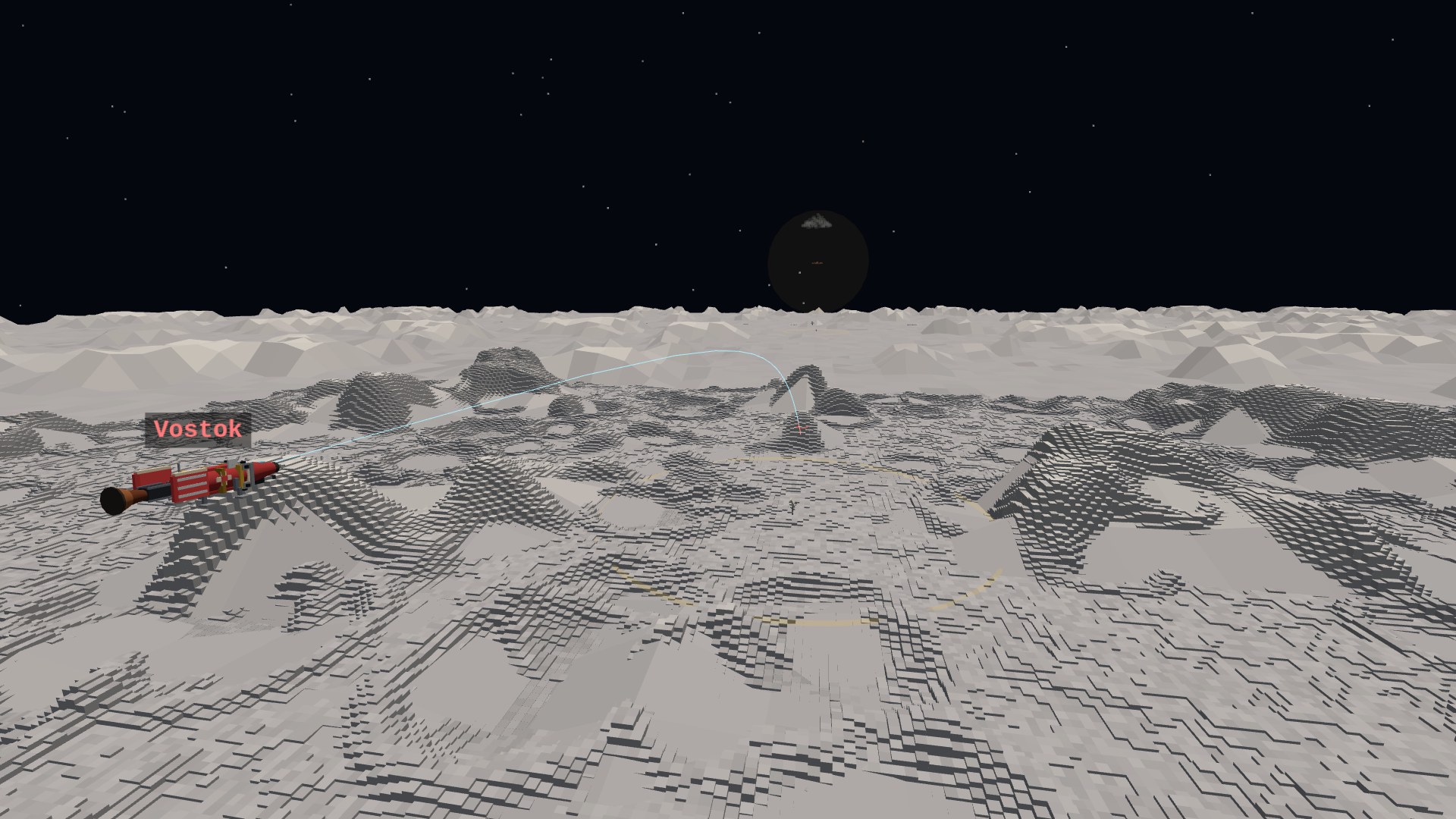
Two instruments turn the well from arithmetic into instinct. The first is your trajectory, drawn straight into the sky ahead of you: a line tracing the next three minutes of your orbit, cyan while it holds, turning red where it starts to sink toward the peaks, ending in a ring on the dust where it ends — if it ends. You don't judge your periapsis off a number anymore; you watch your own future bend, and when it goes red the guidance computer is already easing it back up. Grab the stick if you'd rather do it yourself.
The second is the spotting telescope: hold Z and the sky leaps five times closer. A war fought across kilometres of vacuum is a war of glints — every contact your team has spotted wears a range mark so you know which glint is four kilometres out and which is one, the one your seeker is tracking burns gold, and off-screen threats point in from the edge of the glass. Find them on the plot, close on the mark, confirm in the telescope, and only then commit the fuel. That's the whole discipline of the theater in one sweep of the eye.
Three prizes, three altitudes
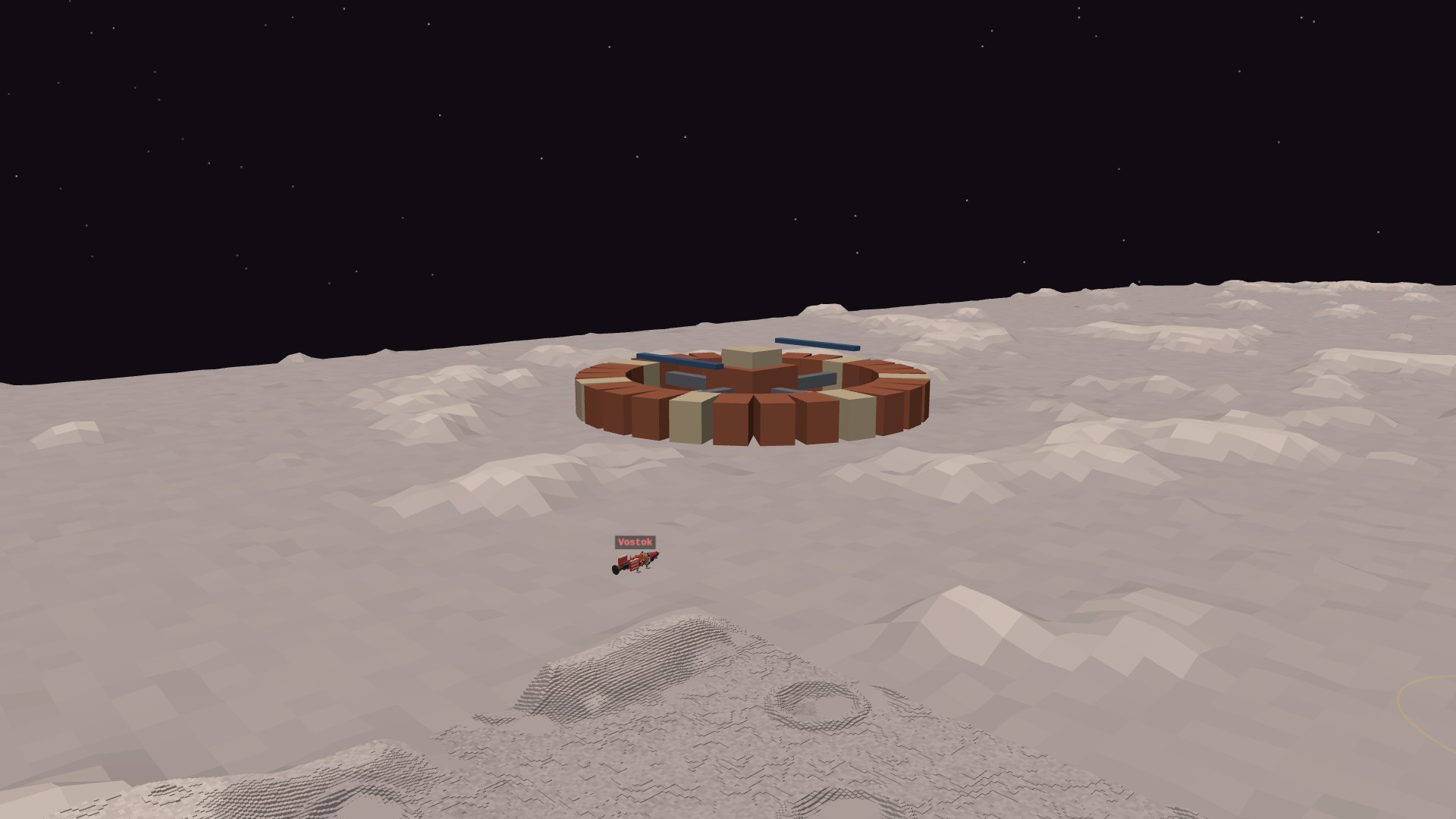
The round is a war for three places, and each one demands a different skill. THE BRICK MOON station — a slow wheel of brick and girders, four hundred metres up — rewards rendezvous: you must get inside its bubble and match its speed, the hardest thing a pilot learns here, and the station won't wait, because it's orbiting too. The two radar relays down on the surface reward landing: only a hull standing on its legs holds them. Look straight down at the prize with the throttle in and the director flies the whole descent — kills your orbit, falls, and argues with gravity at exactly the last moment — to a touchdown soft enough to keep your legs; hold the ground, and relaunch when the war comes looking. Hold a prize and the points tick; hold the relays and the dark side goes bright for your team only.
Four hulls, one tank
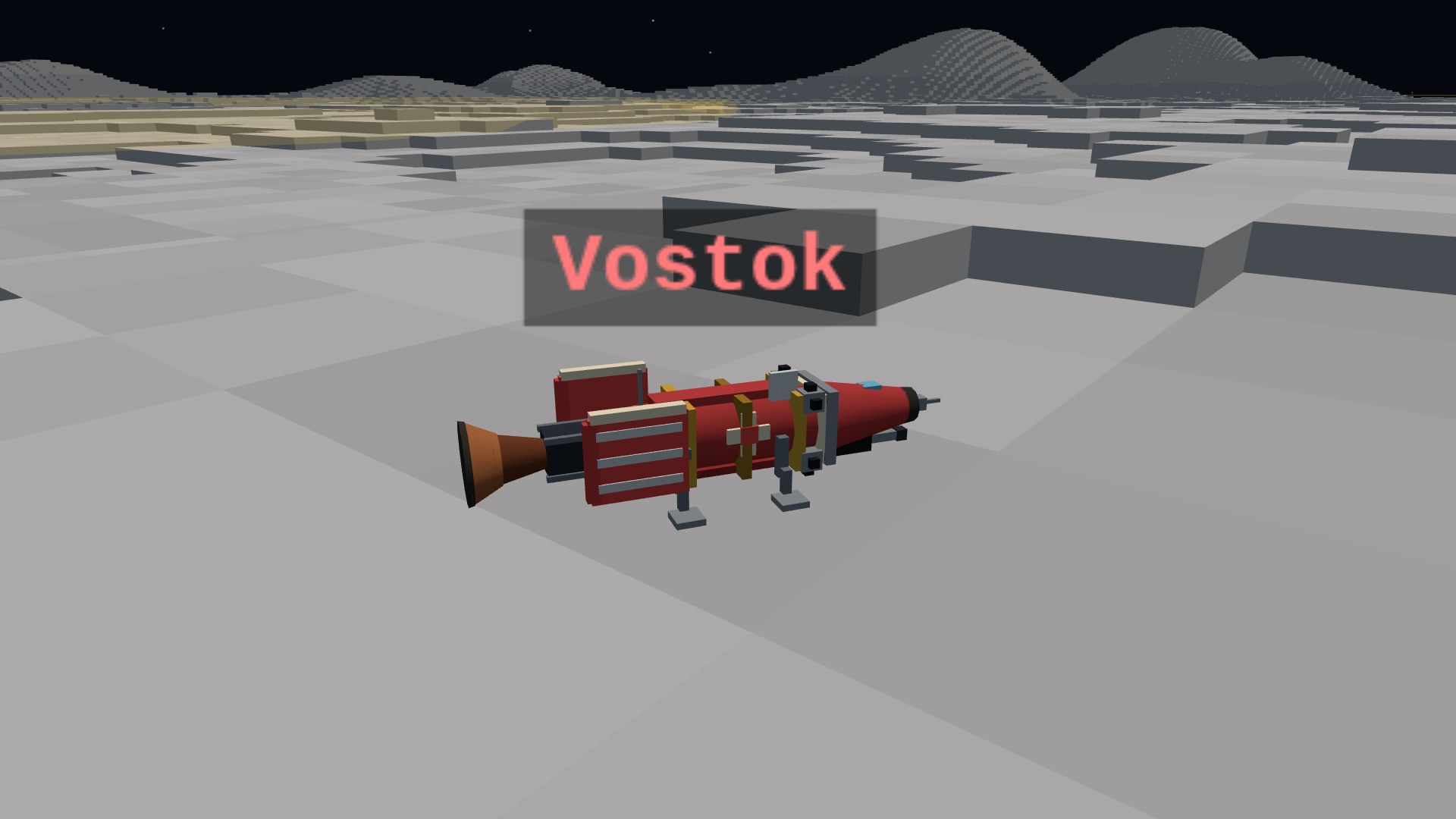
The Dart is the interceptor — a blunt capsule on a service drum with one bell and legs, quick to swing, deep of tank, armed with a 23 mm that teaches you phasing one plink at a time, and two ASAT missiles for the arguments a gun can't reach. The Bastion is the gun corvette — armored crew citadel, twin cheek cannon on one firing line, big solar arrays, the 85 that doubles as an engine, and the patience of a battleship. The Hammer is the ordnance barge: six tungsten rods on an open rack, dropped from the high rail onto anything foolish enough to sit still on the ground — press M and the chart shows the red X where a rod released now would strike; the aim is the moment you let go. And the Mule is the tender: match orbits close aboard and she refills your tank and re-racks your ordnance — which is why she flies with an escort, and why the enemy hunts her first. All four launch, orbit, fight and land with the same handful of controls: look where you mean to go, throttle in to go there, hold fire and let the computer lay the guns — and a chart that tells you the truth.
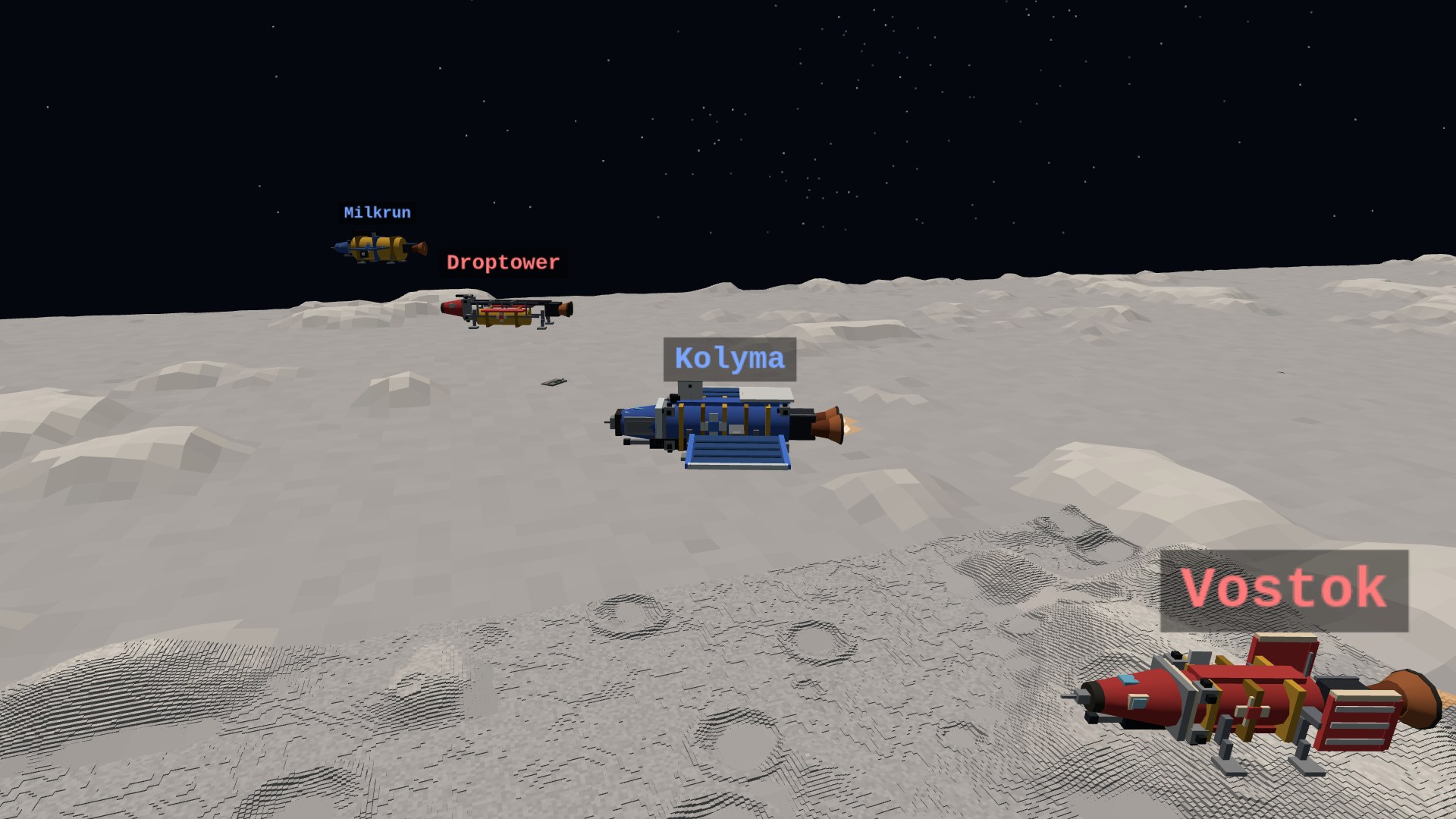
The Brick Moon runs as its own theater, alongside the air war, the fleets, the steppe and the Gulf. Climb the well, read the ellipse, watch the sunrise line — and mind your periapsis.